 |
| Food, water, shelter, exercise --but more than just the basic welfare needs, your pet needs love! |

Sunday, January 30, 2022
What are your basic pet needs?


Friday, August 12, 2011
Seals Killed Legally in Canada
All for the sake of fashion, seals are killed either by gun shots or by crushing their skulls. And worse, this is legal in Canada. Watch this video of how seals are cruelly killed and ask yourself if you would really feel great to own a fashion piece of luxury fur or some dazzling scarfs made of seal's fur/skin.
Tuesday, July 26, 2011
PETA - Fighting Animal Abuse In Manila Zoo, Philippines
Dear Activists,
You are probably aware that the Manila Zoo has once again come under fire for its poor treatment of animals and decrepit enclosures. The treatment of animals at the zoo has been all over the Philippine media since last week, when it became a trending topic on Twitter, both locally and internationally. Please help PETA ensure that the animals' side of the story continues to be told by writing a letter to the editor of a newspaper today!

The Manila Zoo has been internationally criticized for housing animals in cramped, barren cages and for providing substandard care. The animals are relegated to a lifetime of boredom and abuse, often leading to self-mutilation and other types of abnormal behavior. Like all zoos, the Manila Zoo presents visitors with a distorted view of wildlife. In the wild, most animals roam over territories of hundreds of square kilometers, but the entire Manila Zoo measures only 0.055 square kilometers. Even the largest zoos worry that they cannot provide the space, exercise, privacy, and mental stimulation that the animals require—much less fulfill the animals' other complex needs.
The following are talking points that you can rephrase in your letters:
If you would like to further speak up for the animals at the Manila Zoo, please use this form to add your name to the ever-growing list of people who want to see the zoo stop taking in animals and ultimately close its doors.
Thank you in advance for your letters! If you have any questions, please e-mail Activist@PETAAsiaPacific.com.
Very truly yours,
The PETA Asia Team
Republished from an email from PETA received by blogger on July 23, 2011.
You are probably aware that the Manila Zoo has once again come under fire for its poor treatment of animals and decrepit enclosures. The treatment of animals at the zoo has been all over the Philippine media since last week, when it became a trending topic on Twitter, both locally and internationally. Please help PETA ensure that the animals' side of the story continues to be told by writing a letter to the editor of a newspaper today!
The Manila Zoo has been internationally criticized for housing animals in cramped, barren cages and for providing substandard care. The animals are relegated to a lifetime of boredom and abuse, often leading to self-mutilation and other types of abnormal behavior. Like all zoos, the Manila Zoo presents visitors with a distorted view of wildlife. In the wild, most animals roam over territories of hundreds of square kilometers, but the entire Manila Zoo measures only 0.055 square kilometers. Even the largest zoos worry that they cannot provide the space, exercise, privacy, and mental stimulation that the animals require—much less fulfill the animals' other complex needs.
Please consider writing to the following publications. You can access recent articles about the Manila Zoo by clicking on the publication names: Manila Bulletin (editorial@mb.com.ph), The Philippine Star (editor@philstar.com), Manila Standard Today (opinion@manilastandardtoday.com), Philippine Daily Inquirer (opinion@inquirer.com.ph), Malaya (malayanews@yahoo.com), and Business World (editor@bworld.com.ph). Send us your letter printed in any newspaper, and we'll send you a free PETA T-shirt!
The following are talking points that you can rephrase in your letters:
- Seeing animals in barren, decrepit, trash-filled cages at the Manila Zoo does not prompt children to respect animals or teach people anything about how animals behave in the wild.
- Taking children to the Manila Zoo only teaches them is that it's OK to rip animals away from their natural habitats and families, deny them everything that is natural and important to them, and sentence them to a lifetime of boredom at the zoo.
- Children can learn about animals and develop appreciation for them through many means, including books, videos, and the Internet. Consider that the type of animal many children know the most about is the dinosaur—yet no child has ever seen one.
- The Manila Zoo houses animals in environments that could never compare to what they would experience in the wild. The cages are barren, filthy, and filled with trash, and the animals have little environmental enrichment.
- Write "Letter to the Editor" in the subject line of the e-mail.
- Be brief! Sometimes one short, pithy paragraph is enough. Try to keep it to less than 300 words (about half of one typed page). Editors are less likely to print long letters.
- Make sure you include your name, address, and telephone number in your letter. Some newspapers verify authorship before printing letters.
If you would like to further speak up for the animals at the Manila Zoo, please use this form to add your name to the ever-growing list of people who want to see the zoo stop taking in animals and ultimately close its doors.
Thank you in advance for your letters! If you have any questions, please e-mail Activist@PETAAsiaPacific.com.
Very truly yours,
The PETA Asia Team
Republished from an email from PETA received by blogger on July 23, 2011.
Monday, April 18, 2011
If my dog Dags could talk...
Last weekend, I captured spontaneous moments of my dogs through my old motorola razor. There are two things that I learned...first, my old phone can still get good pictures, and second, my dog Dags can have her own soap opera...if she could talk.
 |
| Where is Lola? I saw her earlier in the backyard. |
 |
| Let's wait for her here. I am sure she's just around. |
 |
| I will wait for her here... |
 |
| ..though I'am alone. |
 |
| What keeps her long? |
 |
| I feel sleepy now. |
 |
| Yawwwwnnnnn. |
 |
| I'd better sleep here... |
 |
| Until Lola is back. |
 |
| I told you, she'll be back! |
 |
| Lola is here! Weeeeeeeeeeeeeee! |
Tuesday, February 8, 2011
Meet PopStar Hamster, my dogs' friend
 | |
| Popstar is asking, "Want to sip?" |
Adult hamsters like Popstar drink about 20ml-30ml water per day.
 |
| Popstar posing, living up to his name. |
There are many different kinds of hamsters, but the five most common are Syrians, Dwarf Campbell Russians, Dwarf Winter White Russians, Roborovski Dwarfs, and Chinese. Needless to say, I don't know what breed Popstar is.
Saturday, February 5, 2011
Dog Blogger Wannabe: can my dog eat bread and cheese?
Everytime I am infront of my laptop during the wee hours I am never alone. Kabang, my nine year old dog is just beside me, making sure I am safe while everyone is asleep. He is wide awake maybe because he wants to learn the art of blogging, too; but on second thought, I think the real reason is --he wants to share my midnight snack!
Many of us think that milk (cow's milk) is best for dogs, but we are wrong. As an occasional treat milk is okay, but in larger amounts --according to experts-- milk can cause digestive upset and sometimes diarrhea for some dogs. Though of course some dogs can clear out a bowl of milk with no digestive issues, and fortunately, Kabang and most of my dogs can tolerate occasional dairy in small amounts.
Why milk may not be recommended for dogs? According to ASPCA expert (www.aspca.org), "pets lack significant amounts of lactase, the enzyme needed to break down lactose in dairy products. As a result, some may have difficulty with digestion and end up with stomach upset. Cheese, however, has less lactose than milk and some other dairy products, so it’s less likely to cause problems."
Great, cheese is safe! Though it doesn't mean that if cheese is okay we feed our dogs with lots of it. Remember that too much cheese can constipate them.
How about bread, is it recommended for dogs?According to dog nutrition experts bread is a healthy snack if it is whole wheat bread. Yes, just like vegan's choice of bread. :)
We all want our four-pawed friends live full, healthy lives that's why I want to make sure my pets get the right treats that they also want, besides commercial dogtreats aren't always appealing to them.
 |
| Kabang, the dog blogger wannabe. |

 |
| My dog begging for milk. |
 |
| Aside from milk, he gets the last bite of my sandwich, whole wheat bread with cheese . |

Why milk may not be recommended for dogs? According to ASPCA expert (www.aspca.org), "pets lack significant amounts of lactase, the enzyme needed to break down lactose in dairy products. As a result, some may have difficulty with digestion and end up with stomach upset. Cheese, however, has less lactose than milk and some other dairy products, so it’s less likely to cause problems."
Great, cheese is safe! Though it doesn't mean that if cheese is okay we feed our dogs with lots of it. Remember that too much cheese can constipate them.
How about bread, is it recommended for dogs?According to dog nutrition experts bread is a healthy snack if it is whole wheat bread. Yes, just like vegan's choice of bread. :)
We all want our four-pawed friends live full, healthy lives that's why I want to make sure my pets get the right treats that they also want, besides commercial dogtreats aren't always appealing to them.
 |
| This commercial dog treat isn't appealing to Kabang if he sees me eating more flavorsome snacks. |
 |
| He sleeps after sharing my snacks. |

Friday, February 4, 2011
What makes my pets happy?
 |
| A bag of dry dog food. Price: $28.00 |
 | ||
| Gourmet Dogfood. Price: $2 to $2.5 each. |
 |
| Grooming. Dog hair cut. Price: $25 |
 |
| Mommy's quality time: Priceless! |
Friday, December 31, 2010
Blouse Massacre and the Four Pawed Suspects
I bought myself a Christmas gift -- a black knitted blouse. But my four pawed friends torn it and ate two of its buttons! Maybe they thought it doesn't fit me? :(
I tried to find out who the suspects are, not to punish them but to monitor if it would result in any health problem. Besides, dog trainers/educators say you never punish your dog if you don't catch him in the act.Good for them, I didn't catch them but "scene of the crime evidences" solved the "mystery" of my blouse "massacre".
  |
| My new blouse with two buttons missing and lots of dog hair/fur :( |
I tried to find out who the suspects are, not to punish them but to monitor if it would result in any health problem. Besides, dog trainers/educators say you never punish your dog if you don't catch him in the act.Good for them, I didn't catch them but "scene of the crime evidences" solved the "mystery" of my blouse "massacre".
 |
| Principal suspects IceBaby (far left) and Garci (center), with accessory to the crime Doogal (right). |
Tuesday, December 28, 2010
Dogs deserve Christmas gifts, too! (Santa, they were good boys and girls this year.)
 |
| Doogal loves the treats and dogfood they received this Christmas. |
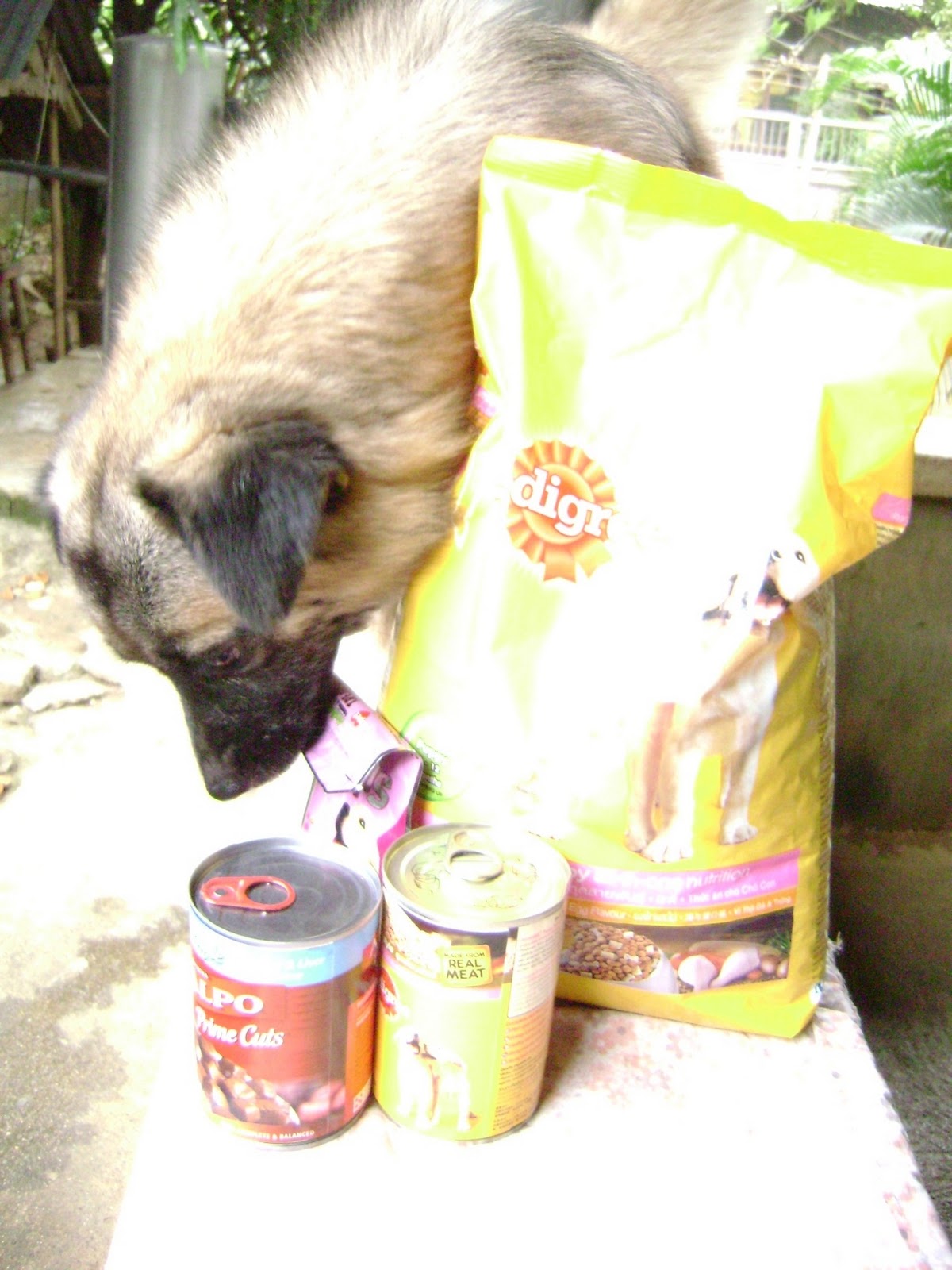 |
| He inspected it first...before he posed for a pic. |
 |
| Honey (above) and Pepsi (below) wanted to pose for picture, too! |
 |
| This is not a product promotion, FYI. |
Saturday, November 27, 2010
Why my dog died? Dr. Marie tells it all.
Before I post here the answer of Dr. Marie, you might ask who she is? She's a well-known veterinarian in Ottawa, and she answers questions online through her site http://www.askavetquestion.com/.
Thank you very much, Dr. Marie for choosing my dog's case to feature on your site, and I am also posting your answer here to help other dog lovers who may be reading my blog.
 Dr. Marie explained why my Sugar died.
Oh, I am so sorry to hear about your ordeal with Sugar and that he did not survive.
I did take some time to read your blog. It sounds like Sugar had excellent vet care.
You mentioned on your blog that Sugar was diagnosed with Ehrlichiosis. This is likely that cause of all of his symptoms.
Ehrlichiosis is spread by ticks. Sometimes a tick can be present on a dog and not be found.
Here is a link to some good information on ehrlichiosis.
One of the most significant things about ehrlichiosis is that it causes really low platelet numbers. When platelets are low it will cause the body to bleed very easily. In your blog you mentioned several signs of bleeding:
I can think of two possible reasons for the serious problem with the foot. The most likely is that Sugar had an infection in that foot possibly as a result of a small wound. But, because he was really low on platelets he could not heal the wound properly. Where a normal dog would have a small bruise, he just kept on bruising and swelling.
The second possibility is if he had something called "vasculitis". Some dogs in the end stages of ehrlichiosis can get a serious problem where the immune system causes tiny molecules to form that can block blood vessels. This causes extreme swelling and purple discoloration.
I am so sorry for all that you went through. From what I read on your blog it sounds like all of the right things were done in his treatment, but sometimes we just don't win against serious disease.
You are definitely welcome to post my reply to your blog. Please rest assured that you did all you could. It sounds like Sugar was a really important part of your family and will be sorely missed.
Dr. Marie
Thank you very much, Dr. Marie for choosing my dog's case to feature on your site, and I am also posting your answer here to help other dog lovers who may be reading my blog.

Oh, I am so sorry to hear about your ordeal with Sugar and that he did not survive.
I did take some time to read your blog. It sounds like Sugar had excellent vet care.
You mentioned on your blog that Sugar was diagnosed with Ehrlichiosis. This is likely that cause of all of his symptoms.
Ehrlichiosis is spread by ticks. Sometimes a tick can be present on a dog and not be found.
Here is a link to some good information on ehrlichiosis.
One of the most significant things about ehrlichiosis is that it causes really low platelet numbers. When platelets are low it will cause the body to bleed very easily. In your blog you mentioned several signs of bleeding:
- Blood in stool
- bruising on the foot and leg
- the black stool (indicates bleeding in the stomach)
- pale gums
- the tiny bruise marks on the abdomen
I can think of two possible reasons for the serious problem with the foot. The most likely is that Sugar had an infection in that foot possibly as a result of a small wound. But, because he was really low on platelets he could not heal the wound properly. Where a normal dog would have a small bruise, he just kept on bruising and swelling.
The second possibility is if he had something called "vasculitis". Some dogs in the end stages of ehrlichiosis can get a serious problem where the immune system causes tiny molecules to form that can block blood vessels. This causes extreme swelling and purple discoloration.
I am so sorry for all that you went through. From what I read on your blog it sounds like all of the right things were done in his treatment, but sometimes we just don't win against serious disease.
You are definitely welcome to post my reply to your blog. Please rest assured that you did all you could. It sounds like Sugar was a really important part of your family and will be sorely missed.
Dr. Marie
Sunday, November 21, 2010
November is the worst month of this year!
 | ||||||||||
| Sugar, the happy dog. |
Everytime I played with my dogs I couldn't help myself but miss Sarsi so I decided to detach myself with my dogs for a week for easy and faster emotional recovery. Exactly a week has passed, my mother said Sugar was limping due to small bruise on his right front foot. We thought he was bitten by my other male dogs since he was always bullied. It was the same day we discovered that the bloody stool we saw that morning and the morning of the previous day was his, so we gave him Metronidazole with vet advise, of course.
The next day his foot was swollen, and we realized that he was licking the bruise as it looked like itchy. He didn't want to eat that morning so we decided to ask the vet to visit. Sugar was given an injectable antibiotic and vitamins. It didn't seem to be a threatening problem, I left the house the whole day but when I went home that night I was shocked to see Sugar "blinded" himself by scratching his right eye! His eyes bulged the next day. The antibiotic and vitamins given to him were continued for three days and we saw some improvements -- the swelling on his foot and eye subsided though not fully, and he ate normally. He was even arrogant with the other dogs --knowing him, I know it was a sign that he felt better.
 | ||||||
| Swollen foot, picture taken before he was brought to the hospital. |
Around 11pm he was given a few injectable medicines/support, some were given intramuscular while some were through the intravenous fluids (dextrose) hooked on his arms. His eye was checked and the vet said it was okay, it was already on healing stage (and he was not blind) but was just clouded with a blood clot. A few minutes after that he started to pant, but I was assured that it was just a sign of stress due to the long travel and the injections administered. Sugar's fecalyis (stool analysis) showed he has mature eggs of hookworms and roundworms! And those worms caused the bloody stool --I do not call it diarrhea because he pooped just once a day for two days and it was black but not watery. Sugar, together with my other dogs, has regular worming schedules, in fact the last time they were given an all-wormer was just two months ago!
In less than an hour Sugar stopped panting and his gums turned a little pinkish, but I noticed his breathing was not normal. The vet said it could be that Sugar's stomach was cramping since he was given Dulcolax. After another hour he pooped (it was black but we didn't see any worms), I felt relieved though --pooping was what I was waiting for, and which I thought would make everything normal to my beloved dog! However I noticed his abnormal breathing did not change but the vet said it was caused by the the worms inside his body --and Sugar will be de-wormed the following day when he has taken enough intravenous fluids to ensure his health. I also noticed two small purple spots on his body and the vet said it could be tick bites.
 |
| Sugar, trying to survive. |
Sugar suffered more, and to assist his breathing he was injected a medicine that will keep his heart pumping every time he could barely breathe. Yes, for a few hours Sugar lived through the machine/medicine support. Still, I did not give up. I asked the vets in the hospital (yes, all of them who were checking him) what could be the best thing to give him. I was told that they have been giving Sugar all the support that hopefully would reverse his blood cells problem but he was not responding to medicines. Last resort was blood transfusion, but one of the vets told me that there is no assurance it will turn out 100% successful! Despite that caution, I still agreed for a blood transfusion --better to take chances than to give up. The vet was able to contact a bloodbank and a possible blood donor, though blood a sample of the donor will still be taken for testing to ensure compatibility with Sugar's.
Sugar was scheduled for blood transfusion the next day provided that his vitals will turn back to normal. While Sugar was trying his best to survive, I told him he will be alright by 5pm, he can breathe effortless again by 5pm. I don't know where I got the idea of the time, but I know I was hoping for a miracle. Fifteen minutes after five, Sugar gasped his last breath.
It is so unfair why my pets who are complete with vaccinations, are dewormed regularly, given vitamins daily, and are kept clean are getting all these problems! While stray dogs live longer life. I don't know why life sometimes is unfair.
Dog Warts turned out deadly
Sarsi was a healthy dog for 11 years until some warts popped up on some parts of his body. I asked the advise of a veterinarian, and got two more second opinions (of course vets, too) and all of them said that treatment was not necessary because my dog developed it due to old age. Multiple warts appeared on his body but which did not affect his appetite, though sometimes we saw him limping when the warts started to erupt. I also asked the vet if it can be removed surgically but I was told that he cannot afford to undergo another surgery due to his age, and because he underwent his 3rd surgery early this year (the first two were different minor problems that needed minor surgeries some years ago) . I felt assured that there was nothing wrong with Sarsi until one day his appetite changed --sometimes he ate a lot, sometimes he just tasted his food --and when he totally missed a meal I brought him to the hospital. Sarsi was confined for three days, but the vet said his vital organs failed (liver and kidney) and they suspected that there were warts on his internal organs, and sadly on the third day he can barely walk. I can't stand seeing him like that so I decided to give him rest, which I was told would be the most humane thing I can give him.
I was guilt ridden for a week, thinking why I gave him up.
I was guilt ridden for a week, thinking why I gave him up.
 |
| Warts on his leg. |
 |
| Warts below his right eyelid and lower lips. |
Monday, November 8, 2010
The most comforting email I received recently
Hi Evs,
Everything will be alright. I know its no consolation and its such a big loss of love to lose a loving pet like Sarsi. I really feel your pain. But know that you have 12 dogs that need your love and affection more right now, you are their BIG MAMA and I hope this thought makes the loss a little bit bearable. In doggy heaven, there is no pain, no sickness - only love and good memories until you meet again. Take it sloow muna, you have your Mama's support din... its a very emotional and trying week for you.Right now, sinisipon ako as I type this, but online ako if you need to talk to someone :)
love you girl!ivypoots
 |
| My Sarsi |
Thursday, October 28, 2010
Can my dog be pregnant by two males?
It is possible for a female dog to carry puppies that were sired by more than one male dog. Puppies can have more than 2 fathers for the same litter.
Answer provided by Bonnie V. Beaver, DVM of AMERICAN VETERINARY MEDICAL ASSOCIATION. See more of her answers to questions on subjects of animal behavior on http://exchanges.webmd.com/pet-health-exchange/groupstory/13552257.
Answer provided by Bonnie V. Beaver, DVM of AMERICAN VETERINARY MEDICAL ASSOCIATION. See more of her answers to questions on subjects of animal behavior on http://exchanges.webmd.com/pet-health-exchange/groupstory/13552257.
Saturday, October 9, 2010
Home service dog grooming
 |
| Charlotte (a mix of Japanese Spitz and Pomeranian) before grooming. |

 |
| Charlotte, the liones, with her stylist. |

Thursday, September 30, 2010
Wednesday, September 29, 2010
Why dog attacks?
Dr. Ian Dunbar explains dog behavior.
Dr. Ian Dunbar is a veterinarian, animal behaviorist, and writer. Dr. Dunbar received his veterinary degree and a Special Honors degree in Physiology & Biochemistry from the Royal Veterinary College (London University) and a doctorate in animal behavior from the Psychology Department at the University of California in Berkeley, where he spent ten years researching olfactory communication, the development of hierarchical social behavior, and aggression in domestic dogs.
Dr. Dunbar has written numerous books, including How To Teach A New Dog Old Tricks, the Good Little Dog Book and a series of Behavior Booklets: separate educational booklets on each of the most common pet behavior problems. Additionally, Dunbar has hosted eleven videotapes on puppy/dog behavior and training, including SIRIUS ® Puppy Training, Training Dogs With Dunbar and Every Picture Tells A Story. All his videos have won a variety of awards.
Dr. Ian Dunbar is a veterinarian, animal behaviorist, and writer. Dr. Dunbar received his veterinary degree and a Special Honors degree in Physiology & Biochemistry from the Royal Veterinary College (London University) and a doctorate in animal behavior from the Psychology Department at the University of California in Berkeley, where he spent ten years researching olfactory communication, the development of hierarchical social behavior, and aggression in domestic dogs.
Dr. Dunbar has written numerous books, including How To Teach A New Dog Old Tricks, the Good Little Dog Book and a series of Behavior Booklets: separate educational booklets on each of the most common pet behavior problems. Additionally, Dunbar has hosted eleven videotapes on puppy/dog behavior and training, including SIRIUS ® Puppy Training, Training Dogs With Dunbar and Every Picture Tells A Story. All his videos have won a variety of awards.
Sunday, September 26, 2010
Dyspnea (Trouble Breathing) in Dogs
 |
| Radiograph of a dog who suffered acute dyspnea for less than 8 hours duration. He has lost some weight over the last month. |

- Syncope/lethargy - due to reduced cerebral perfusion.
- Weakness/reduced stamina - due to reduced skeletal muscle perfusion.
- Dyspnea/wheeze/cough/orthopnea - Dyspnea is due to pulmonary edema or pleural effusion. Cough may occur due to pulmonary edema or due to mitral valve insufficiency with left atrial enlargement and compression of the left main-stem bronchus; this latter cause may often occur in the absence of congestive heart failure. Many dogs with heart failure may not cough, whereas dyspnea, wheezes and sometimes orthopnea (difficulty breathing when lying down) are common historical findings. Some dogs will cough with relatively mild edema and others only cough with severe pulmonary edema. It appears that the speed with which the pulmonary edema develops may play a role in determining when or if cough is to develop.
- Abdominal distention - due to ascites and/or Hepatomegaly or splenomegaly.
With Content by:
Michael R. O'Grady, DVM, MSc, Diplomate ACVIM (Cardiology)
M. Lynne O'Sullivan, DVM, DVSc, Diplomate ACVIM (Cardiology)
Veterinary Cardiology Online, An educational site for veterinary students and practitioners.
Saturday, September 25, 2010
What is the best solution for dog warts?
There are a lot of reasons for little wart like bumps on dogs. True warts are caused by a virus and will generally go away over time when the body recognizes the virus and produces antibodies to fight them off. Another cause of little bumps like this would be what are called skin tags. These are just little skin projections, usually not very hard, that appear and are not dangerouss or necessary to remove. There can also be little bumps that appear when an oil gland duct gets plugged so that the accumulation of the oily material increases and eventually results in a bump. Obviously turmors, both benign and cancerous, can also cause this appearance, but your veterinarian can get a good idea what the problem might be by sticking a needle in them, pulling out some cells, and looking at the cells under a microscope. Most likely these are not problems and really do not need to be removed, but the next time you are in the veterinary office, just ask for an opinion of what they might be.
Answer provided by Bonnie Beaver, BS, DVM, MS.
Bonnie V. Beaver, DVM, is internationally recognized for her work in the normal and abnormal behaviors of animals. She has given more than 250 scientific presentations to veterinary and veterinary student audiences on subjects of animal behavior, animal welfare, and the human-animal bond, and has discussed many areas of veterinary medicine for the public media. She has authored more than 150 scientific articles and has nine published books, including The Veterinarian's Encyclopedia of Animal Behavior (Iowa State University Press), Feline Behavior: A Guide for Veterinarians (W.B. Saunders Company), and Canine Behavior: A Guide for Veterinarians (W.B. Saunders Company). See her complete profile on WebMd.
Answer provided by Bonnie Beaver, BS, DVM, MS.
Bonnie V. Beaver, DVM, is internationally recognized for her work in the normal and abnormal behaviors of animals. She has given more than 250 scientific presentations to veterinary and veterinary student audiences on subjects of animal behavior, animal welfare, and the human-animal bond, and has discussed many areas of veterinary medicine for the public media. She has authored more than 150 scientific articles and has nine published books, including The Veterinarian's Encyclopedia of Animal Behavior (Iowa State University Press), Feline Behavior: A Guide for Veterinarians (W.B. Saunders Company), and Canine Behavior: A Guide for Veterinarians (W.B. Saunders Company). See her complete profile on WebMd.
Friday, September 24, 2010
Subscribe to:
Comments (Atom)